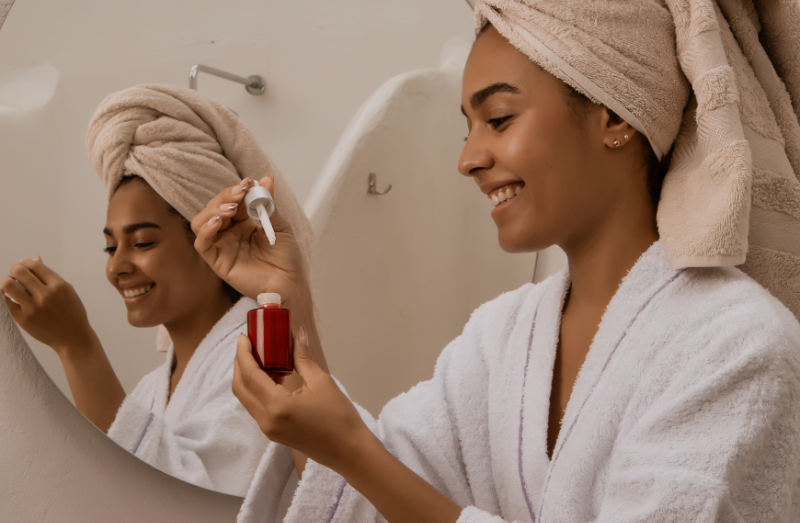
Retinoids and similar active ingredients have carved out a special place for themselves in modern skincare, not just because of their effect on signs of aging, but also due to their role in skin rejuvenation, pigmentation regulation and the improvement of epidermal structure in general. Although sometimes misunderstood, few ingredients have been as well researched as retinoids. However, their usage requires knowledge, patience and an individualised approach. The difference between retinol, retinal and bakuchiol lie not only in their strength, but also in skin tolerance, the speed with which they achieve results and their safety profiles.
Retinoids – the foundation of modern anti-age skincare
Retinoids are vitamin A derivatives which have been the golden standard in the prevention and treatment of signs of aging for decades. Their effect is achieved by binding to nuclear receptors in skin cells, which encourages:
- faster epidermis regeneration
- collagen synthesis
- the reduction of fine lines and wrinkles
- evening out pigmentation.
The clinical effectiveness of retinoids has been confirmed by numerous studies, especially in the context of photoaging and chronic UV damage.
Retinol – the most famous and widely used one
Retinol is the most widely used retinoid in cosmetics. In order to become biologically active, it needs to undergo two enzymatic conversions in the skin, reaching the form of retinoic acid. That’s precisely why its effect isn’t instant, but has been well documented in the long run.
Clinical studies show that consistent retinol use decreases the depth of wrinkles, improves skin texture and encourages collagen synthesis.
However, retinol often causes temporary side effects such as redness, dryness and flaking, especially when beginning usage. It also increases skin sensitivity to UV rays, which makes everyday photoprotection necessary.
Retinal (retinaldehyde) – faster and more potent
Retinal is one metabolic step closer to the active retinoic acid, necessitating only one conversion. That’s precisely why it acts faster and often has a stronger effect than retinol, but with a greater potential for irritation. It’s interesting to note that retinal also exhibits an antibacterial effect, especially against Cutibacterium acnes, which makes it a common choice amongst adults experiencing both acne and signs of aging.
Bakuchiol – a botanical alternative
Bakuchiol is a compound isolated from the seeds and leaves of the plant Psoralea corylifolia, which has traditionally been used in ayurvedic and Chinese medicine. Although it’s chemically not a retinoid, research has shown that it modulates the same molecular paths in the skin as retinol, including the expression of genes connected to collagen production and epidermis renewal.
Clinical studies have shown that bakuchiol can:
- significantly decrease fine lines and wrinkles
- improve skin elasticity and firmness
- even out skin tone and decrease hyperpigmentation.
Unlike retinoids, bakuchiol rarely causes redness, flaking or irritation, which makes it appropriate for sensitive skin and everyday use, while also not increasing skin photosensitivity.
Although bakuchiol is milder and slower than retinol or retinal, in the long-term, it provides well-supported results in anti-age skincare, making it a safer and milder alternative for individuals unable to tolerate retinoids or looking for a milder routine.
Tips for safe use
When using retinol, retinal and other retinoids, it’s important to adhere to some key rules in order to lower the risk of irritation. First and foremost, it’s important to always use sun protection, as retinoids increase skin sensitivity to UV rays. Products shouldn’t be applied to wet skin as moisture increases absorption and can lead to stronger irritation. It is recommended to use products no more than two to three times a week, and it’s important to start with lower concentrations and see how the skin reacts. Combining retinoids with other potentially irritating ingredients, such as AHA or BHA acids or aggressive peelings, can additionally enhance the redness and peeling and is not recommended in the same routine. Another very important thing to note is that retinoids should not be used during pregnancy and while breastfeeding, whereas bakuchiol can be used.
Finally, no ingredient is universally considered “the best” – the best ingredient is the one which best fits skin needs and tolerance. Retinoids remain the foundation of anti-age skincare thanks to their strong and proven ingredients, whereas bakuchiol offers a safer and gentler alternative. Although caution is necessary, with the right choice and careful application, retinoids are a great tool built on a strong clinical foundation.
Literatura
- Dhaliwal S. et al. Prospective randomized clinical study comparing the efficacy of bakuchiol and retinol for facial photoageing. British Journal of Dermatology, 2019, 180(2), 289–296.
- Chaudhuri R.K. Bakuchiol: a retinol-like functional compound revealed by gene expression profiling and clinically proven to have anti-aging effects. International Journal of Cosmetic Science, 2014, 36(3), 221–230.
- Mukherjee S. et al. Retinoids in the treatment of skin aging: an overview of clinical efficacy and safety. Clinical Interventions in Aging, 2006, 1(4), 327–348.
- Sorg O., Antille C., Kaya G., Saurat J.H. Retinoids in dermatology: history, mechanisms of action and clinical applications. Dermato-Endocrinology, 2009, 1(1), 11–17.